The courtroom fell completely silent.
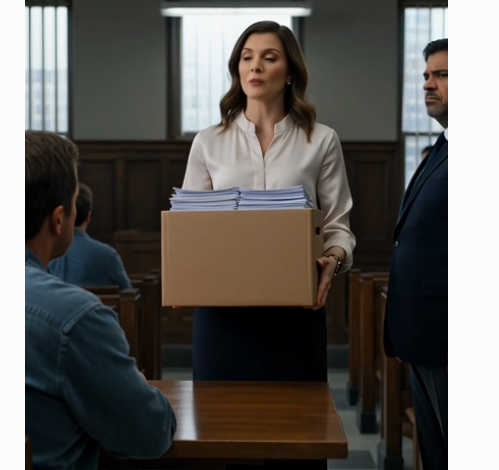
Emily Carter, my daughter’s third-grade teacher, walked slowly toward the front.
She placed the worn cardboard box on the evidence table.
“I’m sorry for interrupting, Your Honor,” she said.
“But I believe these belong in today’s hearing.”
The judge nodded.
“Go ahead.”
Emily opened the box.
Inside were attendance records.
School reports.
Drawings.
Handwritten notes.
And dozens of photographs.
The attorney for my in-laws frowned.
“What exactly is this supposed to prove?”
Emily picked up the first drawing.
It showed a little girl holding her father’s hand beside a small yellow house.
Across the top, written in crooked letters, were the words:
My Dad Is My Hero.
“My students are often asked to draw the person who makes them feel safest,” Emily explained.
“Every single time… Lily drew her father.”
My mother-in-law shifted uncomfortably.
“Children don’t understand what’s best for them.”
Emily looked at her calmly.
“Maybe not.”
“But they know who shows up.”
She handed another document to the judge.
“This is Lily’s attendance record.”
The judge glanced down.
Perfect attendance.
Emily smiled softly.
“Mr. Foster never missed a parent-teacher conference.”
“He attended every school performance.”
“Even if he arrived wearing work boots covered in cement.”
The opposing attorney stood.
“Objection. None of this changes his financial situation.”
Emily nodded.
“You’re right.”
“It doesn’t.”
She reached into the box one last time.
“And neither does this.”
She held up a sealed envelope.
“The principal asked me to bring this only if the court questioned whether David Foster could provide a stable home.”
The judge looked directly at her.
“May I see it?”
Emily handed the envelope to the judge.
Inside was a letter signed by the school principal, the counselor, and three of Lily’s teachers.
The judge read silently for several moments.
Then he looked up.
“This letter states that Lily has consistently described her father as the person who comforts her, helps with homework, prepares her meals, and volunteers whenever the school needs parents.”
Emily nodded.
“She never talks about expensive gifts.”
“She talks about bedtime stories.”
The courtroom remained quiet.
The judge turned toward my late wife’s parents.
“Have either of you attended a parent-teacher conference during the past three years?”
Neither of them answered.
He asked another question.
“Do you know the name of Lily’s best friend?”
Silence.
“What is her favorite subject?”
More silence.
Then the judge looked at me.
“Mr. Foster.”
“What did your daughter have for breakfast this morning?”
I smiled without thinking.
“Blueberry pancakes.”
“She asked for chocolate chips too.”
A few people in the courtroom laughed softly.
The judge closed the file.
“The court has heard enough.”
He looked around the room before speaking.
“A child’s future is measured by more than income.”
“It is measured by love, consistency, and presence.”
He ruled that Lily would remain in my custody.
As I left the courtroom, Lily ran into my arms.
She whispered,
“I knew you’d come.”
I held her tightly.
“I always will.”
Outside, I climbed into my old truck.
It still had cracked seats.
It still smelled like sawdust.
But as Lily buckled herself in beside me, I realized something no courtroom could measure.
Sometimes the richest home…
…is the one where a child never has to wonder if they’re loved.